Details for the Powerful Tennis Serve
When learning to serve, one of the first things many players are taught is to “snap the wrist” at contact. While this action plays a small role in generating spin and directing the ball, it’s often misunderstood—and vastly overemphasized. In reality, the wrist snap is only a minor component of the serve, and focusing too much on it can actually limit your ability to generate true power.
To create high racquet head speed, which is the key to a powerful and effective serve, you must learn to coordinate your entire body structure —not just your shoulder, arm and wrist. A great serve is a movement of a dynamic skeleton- muscle system controlled by the nervous system.
Here’s how that process works in detail
The Legs: Building Ground Force
The serve begins from the ground up. By bending your knees to prepare for the jump, creating the pushing force against the ground and weight. To be clear in mind, jumping by legs is an active action which is different from the rotated torso ( like the compressed spring) that will turn back naturally ( or say inactive) around the spine if you do not hold it. As you initiate the upward motion of the serve, your legs drive explosively upward and create the beginning force upward from pushing ground. This vertical pushing ground force lifts your body and helps initiate the movement of the dynamic skeleton.
The serve begins with a solid base. Your legs act as the foundation for the entire motion. This leg drive is not just a jump—it's the first, vital phase of powering your swing.
Continue Ground Force Through Pelvis and Sacrum
To continue the ground force effectively through the body during a tennis serve, the pelvis must be positioned correctly. The key is keeping the pelvis aligned slightly in front of the femoral heads (the top of the thigh bones). This alignment allows the ground force, generated by the legs pushing against the court, to continue smoothly upward through the hips without being blocked or wasted.
The sacrum, which forms the base of the spine, plays an equally important role. It acts like a bridge between the upper body and the pelvis: it supports the weight of the torso and channels that load evenly into the pelvic structure. When the sacrum is properly balanced over the pelvis, it stabilizes the lower spine and allows the rotational and vertical forces from the legs and hips to continue efficiently into the upper spine, ribcage, scapulars, arms, and finally the racquet through the sequence of skeletal action like whip.
In short, the correct alignment of pelvis and sacrum creates a strong and efficient foundation, ensuring that the force from the ground is carried through the whole kinetic chain during the serve.
Coil the Upper Body: Loading the Torso and Core
As the legs begin to prepare for the upward drive, the upper body must also load elastic force by coiling. This coiling action happens when the shoulders rotate back and away from the net, while the hips, legs, and feet remain more stable and grounded. The result is a separation between the rotation of the shoulders and the position of the hips — Stretch for Elastic Force in STEM for sports.
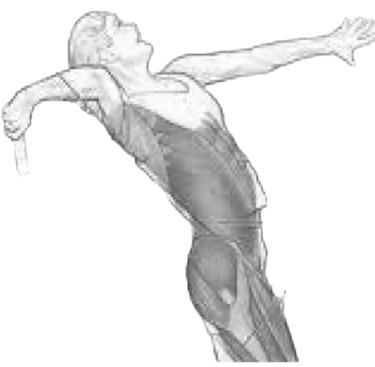
This separation is critical because it creates a rotational stretch across the spine and torso. The rib cage, scapulae (shoulder blades), and deep core muscles are wound up like an elastic band. The more efficiently this coil is created (without over-rotating), the more elastic force is stored.
When the serve transitions into the uncoiling phase, this stored rotational force is released, generating angular velocity through the torso, shoulder, arm and wrist, and eventually the racquet head, building up the overall velocity of the swing.
If this coiling phase is incomplete or weak, the server misses out on one of its primary power sources; instead of the whole torso contributing to the motion, the player is forced to rely mainly on arm strength, which not only reduces racquet head speed but also increases the risk of fatigue or injury.
So, the upper body coil acts as the link between lower body drive and upper body acceleration, ensuring that ground vertical force and horizontal elastic force are combined into one powerful, fluid motion of the whole body.
Shoulder & Upper Arm Align with Core and Torso
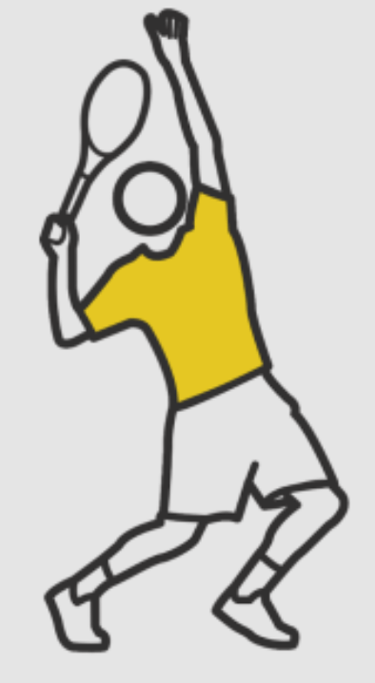
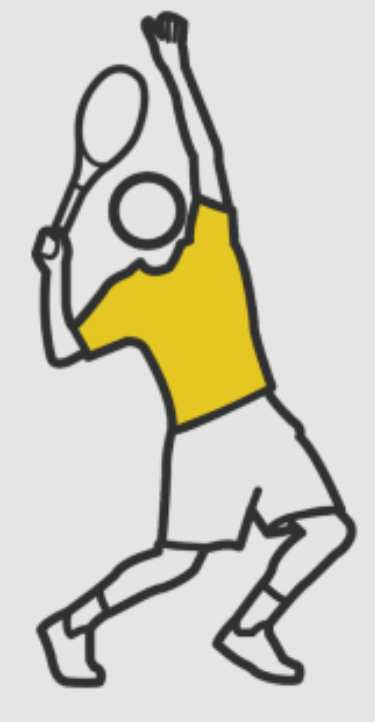
As you squat down while tossing the ball, your upper body should be rotating away—that means your shoulders are turned away from the net, creating an angular elastic force by stretching across your torso. At the same time your right elbow is up and away from the torso and the forearm is moving up holding the racket. As your legs push upward, you make the upper arm down with a racket and begin to unwind your torso, rotating around your spine. This rotation is critical—it creates angular momentum that flows upward through your body and adds tremendous speed to your swing.
This lift-and-rotate movement is where upward and rotational forces combine, setting up the swing. It’s critical that the legs and torso move in sync—not as separate parts, but as one system of skeleton structure.
Think of it like a loaded spring unwinding: the more effectively you coil and then release that coil through the torso and shoulders, the more racket head speed you’ll generate.
This is where racquet head speed begins to build: not from the arm, but from the powerful, smooth rotation of your core.
The Arm Lag: Whip-like Acceleration
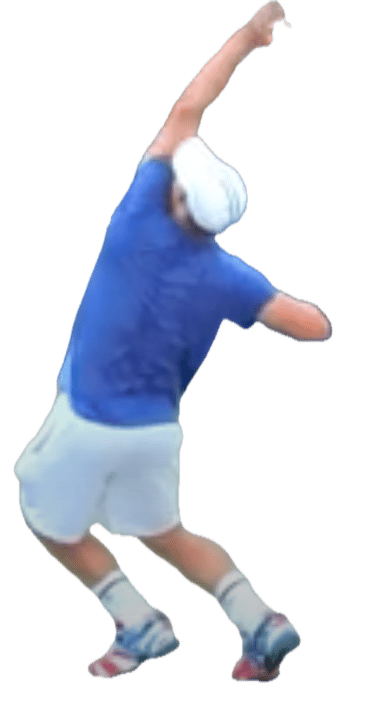
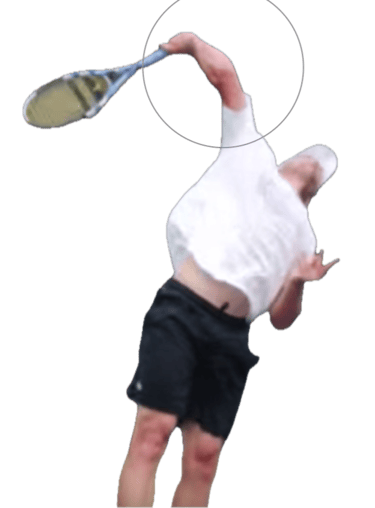
As your torso unwinds, your hitting arm lags slightly behind. This creates a stretch in the shoulder and chest area, similar to pulling back a slingshot. When the arm finally catches up and accelerates forward, it acts like the tip of a whip, releasing the stored elastic force in a rapid, snapping motion. This is where the racquet head speed peaks—not from isolated wrist action, but from the full-body buildup for creating big centripetal force. By the way, the body weight is another part of the centripetal force to pull the hitting arm and racket down at the impact zone.
As the torso rotates, the hitting arm lags behind. This lag creates a stretch across the chest and shoulder—storing even more elastic force and being added opposite direction force from the legs and torso. The racquet should feel like it's trailing behind as the elbow leads the motion. Then, in a whip-like release, the arm is accelerated forward by the opposite direction force, creating the high speed of the racket head which is at the most outside of the circle.
The more connected and relaxed your arm is during this phase, the more efficiently force flows from the body into the ball.
Wrist Snap: A Natural Result, Not a Forced Action
By the time the racquet reaches the contact point, the wrist naturally releases or “snaps” into the ball by the pulling force from the hitting arm down and up during the body’s jumping up and falling down. But this is not a deliberate flick—it’s a result of the dynamic skeleton action, not a cause of the high speed of the racket head. If your body is aligned and timed properly, the wrist action will happen automatically as part of the dynamic skeleton action. Forcing a wrist snap too early or too hard breaks the rhythm of the dynamic skeleton and can even reduce centripetal force or cause injury.
The “wrist snap” so many are taught is not a separate move to be forced—it’s the final, natural release at the end of a well-sequenced swing. If everything before it is done correctly, the wrist will naturally firm up at impact due to inertia and timing. Forcing this motion can break the chain and create tension.
In truth, your wrist stays relaxed through most of the swing, only firming at the moment when the arm is pulled to be straight by both the arm and the racket with opposite directions.