Engineering of Trebuchet: Peak of Two Circles
A trebuchet is a type of compound machine that leverages the mechanical advantage of a lever to hurl a projectile over a great distance. These large structures were once common and highly effective siege engines before the development of gunpowder. The trebuchet primarily consists of a long beam mounted on an axle, which is suspended high above the ground by a sturdy frame and base. This setup allows the beam to rotate vertically through a wide arc. One end of the beam features a sling that holds the projectile, enabling the trebuchet to launch it with significant gravity force.
The trebuchet, although designed by engineering hundreds of years ago, uses complex physics to ensure a high-velocity, long-range launch of a projectile. It is a catapult that makes use of a falling counterweight, a swinging arm and a sling to throw a projectile.
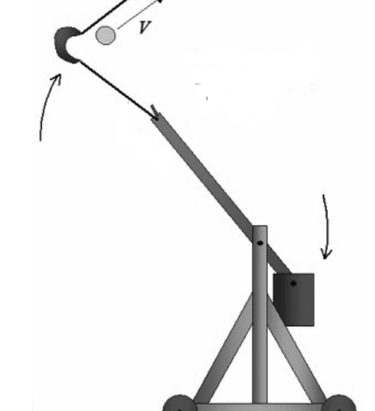
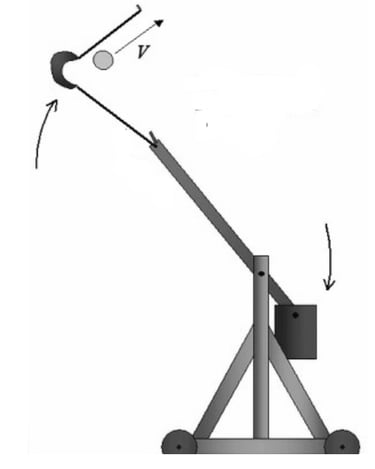
The device consists of a framework that supports a freely revolving launch arm. On one side of the arm, a heavy counterweight is attached; on the other, a long sling containing the projectile. When the trigger is released, the counterweight falls, the weighted short arm is driven by gravity into an accelerating pendulum motion, causing the lighter, long arm of the lever to revolve around the fulcrum at the opposite arc, which in turn, pulls the sling and its contents into a whipping motion at the end of the long arm, forcefully propelling the side of the arm with the sling into the air. The sling then spins in a circular motion around the end of the arm(as the center of a circle and the sling is radius) , further increasing the speed of the projectile before it is released.
A trebuchet uses a lever for its throwing arm, which is attached to a sturdy base by an axle. Trebuchets throw projectiles (these usually sit inside a sling at one end of the throwing arm) by quickly rotating the arm along its axle. Since the sling is attached to the longer end of the arm and opposite to where the force is applied at the fulcrum of the lever, the trebuchet takes advantage of leverage—also called mechanical advantage—to throw a projectile.
One key to the trebuchet’s success is the positioning of the projectile, or payload, sling, and counterweight on the throwing arm. The throwing arm is essentially a basic lever – one can understand how it works through the principle of mechanical advantage. During a launch, the counterweight drops, exerting torque on the lever. Through mechanical advantage, a slower counterweight-end velocity creates a much faster payload-end velocity. As a result, a counterweight with a large mass, which can exert greater force on the lever, creates incredibly fast motion on the payload end of the lever.
One can change multiple variables within a trebuchet when trying to increase the speed of a projectile, or the speed of the racket head .
It is clear that heavy counterweights, long throwing arms, and long slings produce incredible projectile velocity. But what measurements produce the best results? Upon testing trebuchet and researching projectile motion, the conclusion is that:
The counterweight at least twenty times as massive as a projectile was most efficient.
The distance from the fulcrum to the end of the throwing arm should be over three times the distance from the fulcrum to the counterweight.
Ideally, the sling will release when the projectile is traveling at a 45-degree angle to the ground, so the angle of the finger on the end of throwing arm is crucial;
Lastly, the length of the sling should be the same as the length from the fulcrum to the end of the throwing arm.
The key point is there are two circle speeds to superposition: A. fulcrum is the center of the circle for throwing arm; B. The end of the throwing arm is the center of the circle for the sling. Like the wave, superimpose the peaks of two speeds of circles at impact zone, they add together to form a bigger club head speed hitting the ball.
Along with using simple machines, trebuchets rely on gravity, potential energy, and rotational acceleration to loosen projectiles from a sling. For other words, there are two circles that form a bigger wave: constructive interference. The first circle: the center is fulcrum and the throwing arm ( from fulcrum to the point of connecting with the sling) is radius; the second circle: the center is the meeting point of throwing arm and sling, and radius is the sling. As the counterweight falls down, the throwing arm and the sling both then spin in a circular motion; the throwing arm around the fulcrum and the sling around the end of the arm.
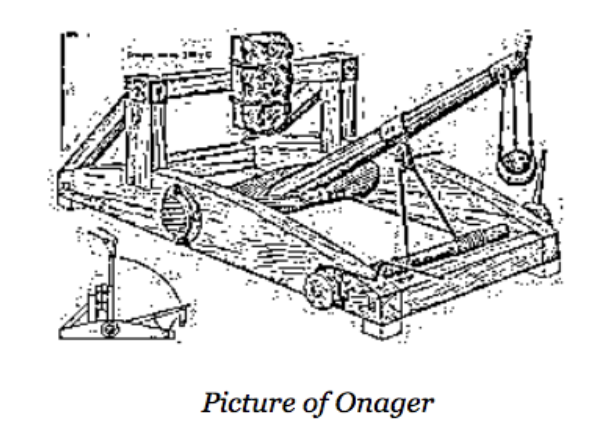
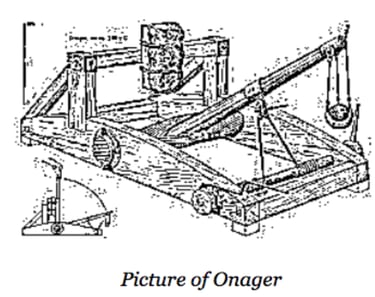
For tennis swing, we don’t have the trebuchet’s counterweight power and the lever system, so the power source of this machine is different from the tennis swing even though the system of long arm and sling is adapted by tennis swing. But there is a machine named Onager that is more like a mechanical structure of tennis swing: instead of the counterweight, the power source of Onager is powered torsion or elastic force, just like tennis swing applies the torsion force restored in the torso during the backswing.
The main power source of the Onager is similar to tennis swing: the elastic force in the twisted body. And the twisted elastic force of the onager is restored in the machine before releasing the projectile, just like the backswing of the torso preparing to hit the ball for a tennis swing. What we really need to learn from the onager is to use the torso’s twisted power only --- no other force from the shoulders, arms and wrists. Doing this way can make sure the radius of the swing circle is the longest: the whole arm plus the racket. For tennis swing, the pulling force from the torso gets the maximum velocity at the impact zone. You can not create the maximum velocity of the racket head if you are not feeling this pulling force at your back at this moment.
Keep the wrists angle of arms and racket during downswing, in other words there is no action of wrist during downswing and impact —— the wrist is very negative and follow the arms just like the sling-top of trebuchet; if the wrists or hands add some force actively to help the racket to hit the ball, that means you superimpose a destructive interference to a constructive interference ---- both of them cancel each other out and lose all the wave power created by legs and torso.
Superposition of speeds on tennis swing: the circle of arms ( the center is humeral head) leads the circle of the racket ( the center is the wrist with grip held by hands), both top positions of the circles will at a same line (nearly) at the impact zone: pulling forces to the body and create a biggest circle and biggest radius, the result is the biggest tangential speed of the racket head;
The Onager can throw the projectile much longer than a similar machine with only a throw arm ( which is the same length of the trebuchet's throw arm plus sling) without the sling. So the superposition concept is crucial for tennis strokes.
So, the projectile’s final velocity at release is the vector sum of the velocity due to the beam’s turning and the velocity due to the sling’s turning relative to the beam. The superposition principle explains the trebuchet’s efficiency: the final motion of the projectile is the result of adding the rotational effects of both the beam and the sling. That’s why a trebuchet can hurl projectiles much farther than a simple catapult: the superposition of the two rotations (beam + sling) creates a much higher release speed or the racket head speed at impact zone..